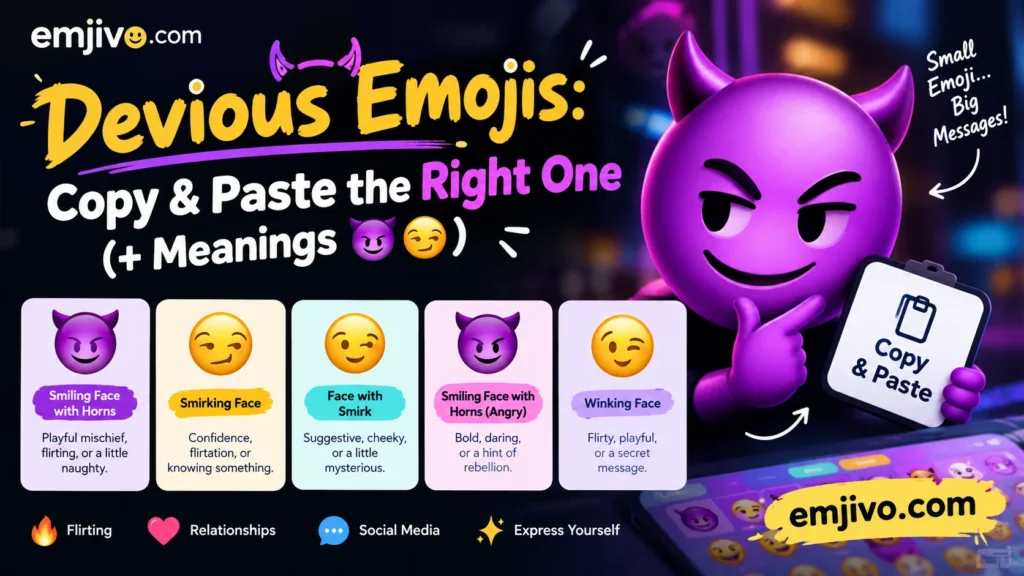
The go-to devious emojis are 😈, 😏, and 😼. Send 😈 when you’re openly being naughty, 😏 when you want to hint that you know something, and 😼 when you want to be sly without sounding sinister.
Copy and paste: 😈 😏 😼 🤫 🤭 🕵️ 🦹
One thing to know before you hit send: there is no emoji officially defined as “devious.” Unicode gives us horns, smirks, and villains, and people assemble the mood themselves. That also means the same emoji can be read very differently depending on who gets it, which is where misunderstandings often start.
Pick by What You Actually Mean
| You want to say | Send | Watch out for |
|---|---|---|
| “I’m about to cause trouble” | 😈 | Can read as suggestive |
| “I know something you don’t” | 😏 | Often read as flirty |
| “Sly, but keep it light” | 😼 | Usually feels lighter than 😏 |
| “Don’t tell anyone” | 🤫 | Needs a joke or plan around it |
| “I can’t stop giggling about this plan” | 🤭 | Mostly means “oops” or “giggle” by itself |
| “I’m snooping” | 🕵️ | Usually reads as nosy, not evil |
| “Evil mastermind, obviously joking” | 🦹 | Usually taken as a joke |
| “I’m actually angry” | 👿 | Not playful |
The Three Main Devious Emojis
😈 Smiling Face with Horns
This is the loudest devious emoji: a grinning face with devil horns, purple on most platforms. Emojipedia says it was approved in Unicode 6.0 in 2010 and added to Emoji 1.0 in 2015.
It’s mostly about mischief and naughtiness, so it fits pranks and “I probably shouldn’t, but” moments. It has a second life too. Emojipedia notes it can express excitement or excellence, in the slang sense of “wicked.” And Dictionary.com points out the part people often forget: it can also carry sexual innuendo.
That’s a wide range for one little face, which is why the words around it do most of the work.
😏 Smirking Face
Worth knowing: 😏 is devious, but it’s most often described as flirty or suggestive first. Emojipedia describes it as sly, smug, mischievous, or suggestive, and says it’s often used to convey flirtation or sexual innuendo. The half-smile, raised eyebrows, and sideways glance are what give it that “I know something” look.
So if you want to look smug after winning an argument, 😏 works. If you want to avoid any romantic reading, think twice.
😼 Cat Face with Wry Smile
Emojipedia calls it the cat version of 😏, with a sly, smug, or mischievous expression. Same attitude, different packaging. A cartoon cat can feel more lighthearted than a human face, so it’s a reasonable pick when you want cheeky without the suggestive edge. That’s my reading of it, not an official rule.
The Two Mix-Ups That Change the Whole Message
😈 vs 👿. Both have horns, but the mouth tells you everything. 😈 grins and is playful; Emojipedia describes it as more playful and suggestive than 👿. 👿 scowls and signals anger or menace. Its official Unicode name is actually “imp,” though most people call it the angry face with horns. Send 👿 as a joke and the other person may think you’re mad at them.
😏 vs 😒. They share similar eyes, so they’re easy to mix up at a glance. The difference is the mouth. 😏 smirks; 😒 (unamused face) is pouty and unimpressed. One says “I’m pleased with myself,” the other says “I’m not buying it.”
How to Be Devious Without Being Flirty
This is the problem the pages I reviewed mostly skip. Because 😈 and 😏 can both read as suggestive, it’s easy to send a romantic signal you never meant. These are practical suggestions, not research findings:
- Choose 😼, 🦹, or 🤫 when you’re unsure. They tend to carry the scheming mood without the same flirty edge.
- Put the joke in words first. “Operation surprise party is a go 😈” is clear. A bare 😈 is a guess.
- Think about who’s receiving it. If the person might be interested in you, they may read any smirk or devil through that lens.
- Match their tone. If they send playful emojis first, you have more room. If they don’t use emojis, a smirk can feel loaded.
- Leave them out of work chats unless the culture there is clearly playful.
Here’s what the safer version looks like:
Jonah: What if we swap everyone’s desk nameplates?
Priya: 😼 I’m in.
Priya sounds on board and mischievous, and it’s unlikely to be read as flirting.
Emojis That Add the “Scheming” Layer
These aren’t devious alone, but they help you build the mood.
- 🤫 Shushing face: “Keep this between us.” Great next to 😈 for surprises.
- 🤭 Face with hand over mouth: Mainly a giggle or a “whoops.” It becomes sly when a secret is involved. Its original Unicode name was “smiling face with smiling eyes and hand covering mouth,” approved in 2017.
- 🕵️ Detective: Snooping or “I’m onto you.” Unicode’s original name for it was “sleuth or spy.”
- 🦹 Supervillain: Cartoon evil. Approved in 2018, and usually a joke.
Two to handle carefully:
- 🥷 Ninja stands for stealth, but Emojipedia notes it’s also considered racist in some contexts, especially when used to insult Black people. For a devious joke, you have safer choices.
- 🐍 Snake can hint at cunning, but online it’s more often an insult for someone seen as treacherous. Sent to a friend as “you sneaky one,” it can land as an accusation.
Devious Emoji Combinations
Combos are informal and shift between friend groups, so treat these as common patterns, not rules.
| Combo | Usual feel |
|---|---|
| 😏😈 | Smug and openly mischievous |
| 🤫😈 | A naughty secret or surprise |
| 🤭🕵️ | Giggly snooping |
| 😼🕵️ | Playfully nosy |
| 🦹😈 | Over-the-top villain act |
Why You Can’t Find a “Rubbing Hands” Devious Emoji
If you’re picturing a face rubbing its hands together or steepling its fingers, you’ve probably seen it in Discord, Slack, or Twitch. Those are custom emotes uploaded by communities. They only work where someone has installed them, and they’re not in the standard Unicode set, so they won’t show up on your phone keyboard.
For normal texting, the closest you can get is a combination, such as 😏 with 🦹 or 😈 with 🤫.
Devious Emojis in Real Messages
These conversations are invented examples to show tone.
The harmless surprise
Aisha: I told Zane his birthday dinner is “just pizza.” 🤫😈
Kim: He’s going to lose it.
The 🤫 marks it as a secret, so the 😈 feels affectionate rather than sinister.
The hype 😈
Dev: Just got front-row tickets. 😈
Maya: Okay, I’m jealous.
No plot here. Dev is pleased with himself, which matches the “excitement” meaning Emojipedia lists. It works because the sentence is about a win, not a scheme.
Same words, different feeling
Chloe (to a teammate): Watch me. 😏
Chloe (to someone she’s been flirting with): Watch me. 😏
In the first, it’s confident trash talk. In the second, the same smirk adds a flirty edge. Nothing about the emoji changed; the relationship did.
Where it goes wrong
Manager: Can you cover Friday’s shift?
Employee: Sure. 😈
Without a joke around it, 😈 in a work chat could mean sarcasm, resentment, or something else entirely. A plain “Sure!” avoids the problem.
Why the Same Emoji Can Look Different
Emoji designs vary by platform and have changed over time, and the mood changes with them.
- 😈: purple with a wide grin on most platforms. Emojipedia notes that Facebook’s version has black horns and green eyes, while older Google and Samsung versions were orange-red. Google once used a frown.
- 😏: Emojipedia flags that its appearance has historically differed greatly across platforms. Early Samsung and Microsoft versions had closed eyes, which looked more contented than smug.
- 🤭: Apple’s original design was later assigned to a different emoji, 🫢 (face with open eyes and hand over mouth), so older and newer devices can show different looks.
You can’t control what the other person sees. If tone matters, keep your words clear enough that the emoji is a bonus, not the whole message.
Someone Sent You One: How to Read It
Check the words around it, the relationship, and what you were just talking about.
| What you see | Likely reading |
|---|---|
| 😈 after a joke or prank idea | Playful mischief |
| 😈 after good news about themselves | Excitement or pride |
| 😈 in a flirty conversation | Suggestive, teasing |
| 😏 after your win | Smug admiration or friendly teasing |
| 😏 in a romantic conversation | Likely flirting |
| 😼 in a group chat | Low-stakes, silly scheming |
| 🐍 aimed at a person | Likely an accusation or insult |
| 👿 in any context | Anger or dark humor, so check the words |
Treat this table as a starting point, not a decoder. If you can’t tell, ask. “Is that a joke?” costs you five seconds and can save you a misunderstanding.
FAQ
What is the most devious emoji?
😈 is the most direct option. 😏 suits quieter, smug mischief, though it often reads as flirty too.
Is 😏 always flirty?
No, but it’s one of its most common readings. Context decides whether it’s smug, teasing, or flirty.
What does 😈 mean in slang?
Mischief and naughtiness mainly, but also excitement or “wicked” in a positive sense, as in a great win.
What emoji means “I’m plotting something”?
Nothing official. People use 😈, 🦹, 🤫, or a combo like 😏😈.
What’s the difference between 😈 and 👿?
😈 grins and is playful. 👿 scowls and signals anger or menace.
Is there a standard emoji for rubbing hands together?
No. Images like that are custom emotes for platforms such as Discord and Slack.

Shahzad is a digital communication writer at Emjivo.com, passionate about emoji meanings, texting slang, and online expressions. Alex creates simple, helpful guides to help readers understand emojis and communicate better in everyday conversations.